Type “AI sewing pattern generator” into a search bar and a dozen tools promise the same thing: upload a photo or describe a garment, get a printable pattern in minutes. Sewists who have actually tried these tools tell a different story — garbled instructions, sizing that doesn’t match the finished garment, and previews that look nothing like what ships.
The stakes are real money and real fabric. A bad pattern from a $12 PDF is an annoying afternoon. A bad pattern sold on Etsy as “original” is a scam, and buyers have been pushing back hard.
The quick answer: most tools marketed as “AI sewing pattern generators” produce an image of a garment, not a sewable pattern. A small number produce something closer to real pattern pieces, but every capability claim comes from the vendor, and the sewing community — loudly, as of late 2025 — has stopped giving these tools the benefit of the doubt.
Here is what each tool actually does, why the largest sewing subreddit banned the category outright, and where an AI-assisted pattern might still be worth the fabric.
What an “AI Sewing Pattern” Actually Is (And Isn’t)
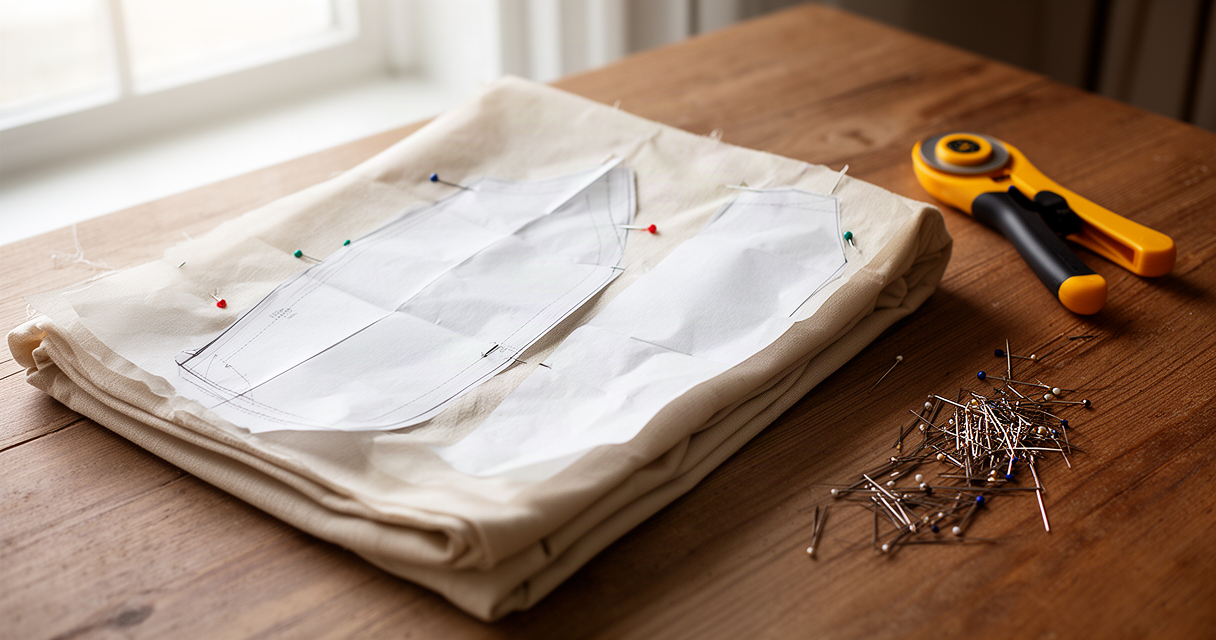
A real sewing pattern is a set of nested, graded pieces — each one seam-allowanced, marked with grainlines, notches, and darts, sized across a range (XS through 3XL, say) so the pieces scale correctly at every size instead of just stretching a single drawing.
That is the product a home sewist actually needs: something a cutting table and a rotary blade can work from.
Most tools calling themselves “AI sewing pattern generators” output something else entirely — a flat image that looks like a pattern piece, generated the same way an AI tool generates a picture of a dragon or a car. There is no grading logic, no seam allowance calculation, no dart math running underneath. It is a picture, dressed up as a pattern.
The distinction matters because it determines whether the file is usable at all. A picture of a bodice cannot be cut and sewn into a bodice unless someone drafts the actual construction geometry — the curves, the ease, the seam allowance — around it. A handful of tools attempt that drafting step. Most don’t even try.
Why r/sewing Banned AI Sewing Pattern Generators Outright
On November 25, 2025, r/sewing added Rule 8: no generative-AI content, full stop. The announcement thread pulled roughly 16,800 upvotes — an unusually large response for a subreddit rule change, and a signal of how much frustration had built up.
The moderators’ reasoning was specific, not reflexive: AI-generated patterns were showing up as “unworkable,” and a wave of Etsy listings were using AI-faked or stolen product photos to sell patterns that either didn’t exist as described or didn’t construct the way the listing claimed.
That frustration wasn’t contained to one thread. A separate post titled “I HATE AI SEWING PATTERNS” circulated with similar energy, and r/sewingpatterns has run its own recurring threads about sewists feeling fed up with AI patterns cluttering pattern marketplaces and pattern-request threads.
The pattern in the pattern community, so to speak, is consistent: people who actually cut fabric for a living or a hobby are not confused about the difference between a generated image and a drafted pattern, and they are tired of being sold the former as the latter.
The Tools, Rated Honestly
Every capability claim below is the vendor’s own — no independent testing of accuracy or fit was found for any of these tools. Pricing is reported from vendor pages and should be confirmed live before anyone pays.
| Tool | What It Claims to Do | What It Appears to Actually Output | Reported Pricing (confirm live) | Honest Read |
|---|---|---|---|---|
| StitchLift | Photo or text to pattern, with seam allowances, XS–3XL grading, export to PDF/SVG/DXF, “accurate within 1/8–1/4 inch” | A functioning pattern editor with tiered accounts — closest of the group to producing real pieces, per the vendor | Free (20 lifetime patterns, watermarked) / Creator about $34/mo / Studio about $49/mo | Real product, unproven claims |
| PatternGen | Text/photo to pattern via Google Gemini | Screenshot/SVG output; the tool’s own interface warns results are “geometric estimations” | Not clearly priced (small hobby/demo app) | Most honest of the group — says its own limits out loud, including recommending a muslin test before cutting real fabric |
| CGDream | ”AI pattern generator” | A general-purpose AI image generator; the same platform generates dragons and futuristic cars | Credits-based (confirm live) | Not a pattern tool — an image generator with a sewing skin |
| myaiart.io | ”Sewing pattern generator” alongside fabric/woven-texture generators | Generic AI images from a credits-based text-to-image engine | About $0.049 per credit (reported) | Same story as CGDream — image generator, not drafting software |
| Style3D.ai | 3D garment visualization and pattern tools | Enterprise CAD software in the CLO3D category, built for brands and factories | Enterprise pricing (confirm live) | Real software, wrong audience — “best for home sewists” posts are marketing, not the product’s actual use case |
| FashionINSTA | AI pattern-to-production for brands with existing pattern libraries | B2B tech-pack and DXF pipeline into factory production | About €299/mo (reported) | Explicitly not built for individual sewists |
StitchLift is the only tool on this list drawing direct scrutiny from the sewing community for its claims. A r/sewingpatterns thread asking about the tool drew an immediate, pointed reply: “Do you know how universally despised AI patterns are by ppl who actually sew?” That reaction — skepticism first, before anyone had even tested the output — is the current baseline sentiment toward the entire category.
CGDream and myaiart.io are functionally the same product wearing different branding: generic AI image generators running near-identical templated landing pages for “fabric generator,” “woven pattern generator,” and “sewing pattern generator.” Calling either one a pattern tool is a stretch of the word.
What AI Still Doesn’t Handle About Fit
Drafting a sewing pattern that actually fits requires solving problems that have nothing to do with generating a plausible-looking image: calculating ease across a body, placing and rotating darts so they land where the body actually curves, blending curves at the armscye, crotch, and neckline so seams lie flat, and grading consistently across a size range so a size 14 isn’t just a stretched size 8.
An AI image generator has no model of any of that. It renders pixels that look like a garment from the training data it has seen — it isn’t solving the geometry underneath.
Sewists reporting on their experiences with AI-generated patterns (by subreddit, not by individual account) describe a consistent set of failures: missing or garbled construction instructions, no guidance on dart placement or strap length, finished measurements that don’t match the sizing stated on the pattern, and necklines or facings described in a way that simply can’t be constructed as written. Several reports also flag a mismatch between the preview photo and the pattern that actually ships.
None of that is a testable claim from this article — it’s what the community itself has been reporting across r/sewing and r/sewingpatterns since the AI pattern wave started showing up in marketplaces. But it lines up with the basic drafting problem: an image generator was never solving for fit in the first place.
Which Garments Might Actually Be Safe to Try
The risk scales directly with how much shaping a garment needs. Low-ease, boxy shapes are the closest thing to a safe bet: totes, pouches, aprons, boxy tops, and elastic-waist or A-line skirts don’t depend on precise dart placement or curve blending to hang correctly.
Fitted bodices, pants, anything with darts or princess seams, set-in sleeves, negative ease, or a garment that needs grading across sizes sits at the other end. Those are exactly the constructions where the missing geometry shows up as a garment that doesn’t fit.
A sewing YouTuber covering the AI pattern trend offered a useful shorthand: keep AI-assisted attempts to very simple line patterns — tunics, skirts, bags, kaftans, raglan sleeves — and avoid anything multi-panel, like a tailored dress shirt or a corset. That heuristic isn’t a technical guarantee, but it tracks with where the drafting math gets hard.
The safest way to treat any AI-generated pattern output, regardless of the tool, is as a rough shape to muslin-test — never as a final cutting pattern for good fabric.
Buying on Etsy: A Checklist Before You Pay
Etsy’s pattern marketplace has absorbed a lot of this problem, since a listing photo is easier to fake than a working pattern is to draft. A few signals sewists have flagged as reliable warning signs:
- The preview photo is a rendered image, not a line drawing or technical flat. A real pattern listing shows the actual technical drawing, not just a styled photo of a finished garment.
- AI “tells” in the model photos — extra or oddly shaped fingers, blurry or inconsistent backgrounds, or a run of models who all look uniformly airbrushed and interchangeable.
- The seller can’t answer basic construction questions — doesn’t know what a facing is, can’t describe how a dart in their own pattern is supposed to be sewn.
- The price is suspiciously low and there are no photos from real buyers who finished the garment — just the seller’s own renders.
- A huge catalog of “original” patterns appearing all at once, more than one person could reasonably draft and test.
r/sewing maintains an informal running checklist along these lines for evaluating Etsy listings before buying, and refunds are commonly granted once a buyer demonstrates a pattern’s AI origin — Etsy’s own policies tend to side with buyers once the evidence is clear.
The Free Alternative: Learn to Draft, or Use Real Drafting Software
Seamly2D is the most credible free option in this space, and it isn’t AI at all — it’s free, open-source (GPLv3+) parametric pattern-drafting CAD, available on Windows, Mac, and Linux, with DXF and PDF export. It requires learning actual drafting principles, but the output is real, calculable geometry, not a generated guess.
Non-generative, computer-assisted tools like Tailornova sit in between — they use measurements to build a pattern algorithmically rather than generating an image, though the result still needs fit-testing like any pattern.
The stronger long-term move for anyone serious about sewing their own clothes is learning to draft blocks and slopers directly. One sewist, reflecting on having learned drafting early, put it plainly: they were glad they had, “otherwise I would have absolutely fallen for these garbage patterns.” Free and slower beats fast and fake, especially once fabric is on the cutting table.
Who This Is (and Isn’t) For
A hobbyist sewist wanting a quick tote bag or a boxy elastic-waist skirt pattern to tweak is the closest thing to a reasonable use case for these tools — low stakes, forgiving construction, and a muslin test catches most problems before good fabric gets cut.
A sewist chasing a fitted dress, tailored pants, or anything with set-in sleeves is better served learning to draft or working from a tested commercial pattern. None of the tools reviewed here have any independently verified track record on fit-critical garments.
It’s also worth separating this category from a different market entirely: brands sending specs to a factory need a completely different toolset than a home sewist ever will. FashionINSTA’s B2B pipeline and the broader category of AI tech pack generators built for brands sending specs to a factory solve a manufacturing problem, not a “help me sew this at home” problem — worth knowing before anyone assumes an enterprise tool will translate to a home sewing room.
The Skeptical Verdict
Most tools branded as “AI sewing pattern generators” are AI image generators that happen to point their prompts at garments instead of dragons. CGDream and myaiart.io fall squarely into that bucket. Style3D.ai and FashionINSTA are real software solving a real problem for the wrong audience. StitchLift and PatternGen are the only two attempting the actual job — one confidently, one with its limitations stated up front — and neither has independent verification behind its fit claims.
r/sewing’s decision to ban the category outright, backed by roughly 16,800 upvotes of agreement, is the strongest signal available right now: a community that actually cuts and sews for a living or a hobby looked at what AI pattern tools were producing and decided it wasn’t worth the trouble of sorting the rare workable output from the flood of unworkable ones.
That reaction sits inside a wider pattern. The sewing community’s rejection of AI-generated patterns tracks closely with the broader backlash against AI in fashion and craftsmanship, where the objection isn’t to AI as a category but to AI being sold as a replacement for skill it hasn’t actually demonstrated. Sewing pattern drafting is exactly that kind of skill — decades of accumulated technique around ease, grading, and curve blending that an image generator has no model of.
An AI-generated garment image can be a useful mood board. It is not, on the current evidence, a pattern.
Frequently Asked Questions
Can AI actually generate a real sewing pattern I can cut and sew?
Rarely, and not reliably. Most tools output an image that resembles a pattern piece without the underlying seam-allowance, grading, or dart-placement calculations a sewable pattern needs. A small number of tools, like StitchLift, claim to solve for that, but those claims are unverified by anyone outside the company.
Why did r/sewing ban AI-generated content?
The subreddit added Rule 8 on November 25, 2025, after moderators cited AI-generated patterns being “unworkable” and a wave of Etsy listings using AI-faked or stolen photos. The announcement thread drew about 16,800 upvotes, reflecting broad community agreement.
What’s the difference between an AI-generated “pattern image” and a real pattern?
A real pattern is nested, graded across sizes, and marked with seam allowances, grainlines, notches, and darts — everything needed to cut and construct the garment correctly. An AI-generated image is a picture that looks like a pattern piece but usually lacks that underlying construction geometry entirely.
Is StitchLift legit, or is it the same as the AI image generators?
StitchLift is a real, functioning product with an editor and paid tiers, which puts it ahead of pure image generators like CGDream or myaiart.io. Its accuracy claims — including “within 1/8–1/4 inch” — are the vendor’s own and have not been independently verified.
What garment types are safest to try with an AI pattern tool?
Low-ease, boxy shapes: totes, pouches, aprons, boxy tops, kaftans, and elastic-waist or A-line skirts. Avoid fitted bodices, pants, anything with darts or princess seams, set-in sleeves, or negative ease, where fit depends on drafting precision AI tools haven’t demonstrated.
How can I tell if an Etsy sewing pattern was made with AI before buying?
Check whether the listing shows an actual technical drawing rather than just a styled render, look for AI “tells” in any model photos (odd hands, inconsistent backgrounds), and ask the seller a basic construction question. A seller who can’t explain their own pattern’s construction is a strong warning sign.
Is Seamly2D a good free alternative to AI pattern generators?
Yes, for anyone willing to learn drafting fundamentals. Seamly2D is free, open-source, parametric drafting CAD with real DXF and PDF export — the geometry is calculated, not generated, which makes it fundamentally different from an AI image tool.
Will AI pattern generators get good enough to trust for fitted garments?
Possibly, eventually, but nothing on the market right now has independently verified accuracy on fit-critical construction like darts, set-in sleeves, or grading. Until that verification exists, any AI-generated pattern for a fitted garment should go through a muslin test before real fabric gets cut.
Cut the Muslin Before You Cut the Fabric
The category split here is clean: image generators dressed as pattern tools (CGDream, myaiart.io), enterprise CAD sold to the wrong audience (Style3D.ai, FashionINSTA), and two smaller tools actually attempting real pattern drafting (StitchLift, PatternGen) with claims nobody outside the company has confirmed.
For a boxy bag or a simple elastic-waist skirt, an AI-generated shape is worth a test muslin. For anything fitted, the sewing community’s own verdict — a rule ban, thousands of upvotes, and a running Etsy warning checklist — is hard to argue with.
Treat every AI-generated pattern the way a sewist treats a pattern from a stranger: cut the test version first, trust the finished garment second.
References
- r/sewing — Rule 8 “No gen-AI content” announcement thread, November 25, 2025 (~16,800 upvotes)
- r/sewing — “I HATE AI SEWING PATTERNS” thread
- r/sewingpatterns — thread on being “fed up with AI patterns”
- r/sewingpatterns — thread discussing StitchLift, including the reply “Do you know how universally despised AI patterns are by ppl who actually sew?”
- r/sewing — “before you buy that Etsy pattern” community checklist thread
- r/sewing — sewist comment on learning pattern drafting early, “otherwise I would have absolutely fallen for these garbage patterns”
- PatternReview forum — community discussion of AI-generated sewing patterns
- StitchLift — official product/pricing page, https://stitchlift.com (confirm live)
- PatternGen — https://pattern-gen.vercel.app (confirm live)
- CGDream — official site, https://cgdream.ai (confirm live)
- myaiart.io — official site, https://myaiart.io (confirm live)
- Style3D.ai — official site, https://www.style3d.ai (confirm live)
- FashionINSTA — official site, https://fashioninsta.ai (confirm live)
- Seamly2D — GitHub repository, https://github.com/FashionFreedom/Seamly2D
- Minerva Patterns — Seamly2D overview and tutorial content
- A sewing YouTuber — video covering AI-generated sewing patterns and a simple-line-pattern heuristic
Tool capabilities described here are the vendors’ own claims, not independently verified; pricing and availability are reported as of publication (August 2026) and change frequently — confirm on each vendor’s own site before paying. Community sentiment is drawn from public forum and video discussion and reflects individual experiences, not a controlled test.