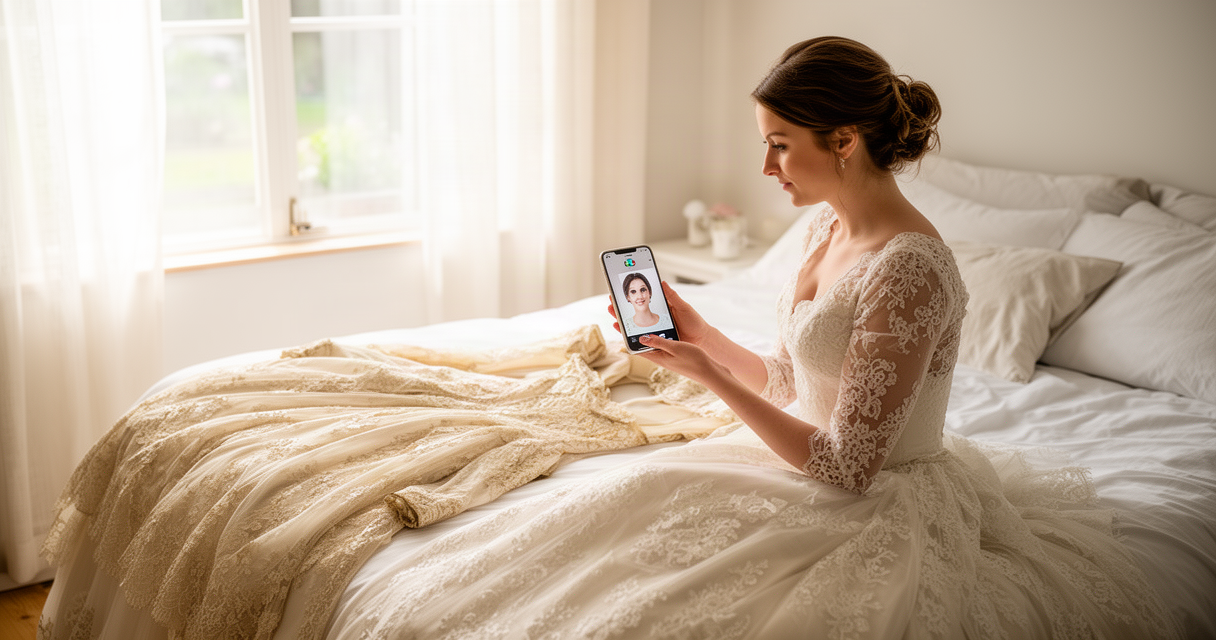
A secondhand wedding dress listed on Stillwhite at a third of retail is a familiar temptation for budget-conscious brides. The catch is usually the same: final sale, no in-person fitting, and the only preview available is whatever an AI try-on app renders on top of a personal photo.
The stakes are higher than casual online shopping. A secondhand gown is typically one-of-a-kind, non-refundable, and often the single most expensive dress a buyer will ever purchase. Most AI wedding dress try-on apps were built for browsing convenience, not for verifying whether a $500–$3,000 gown — worn once, sold as-is — is actually safe to buy sight unseen.
The short version: AI wedding dress try-on apps are useful for one narrow job. They rule out silhouettes, necklines, and colors that are obviously wrong for a given body before any money changes hands. They are not accurate enough to verify fabric weight, drape, structural bodice fit, or the true condition of a used dress — the exact variables that determine whether a secondhand, no-returns purchase goes well. Treat the app as a first filter. Everything after that — measurements, seller photos and video, a tailor’s opinion — still requires human verification.
Why Everyone’s Suddenly Asking This
The question is showing up more often for a reason: try-on technology just got pushed in front of a much larger audience.
Google shut down its standalone Doppl try-on app on April 30, 2026, folding the underlying technology directly into Search and Shopping instead of keeping it as a separate destination (Google Labs Help, 2026). That single change put a try-on button in front of anyone searching for a dress, not just users who had downloaded a dedicated app.
Alongside that shift, Google partnered with fashion-specific platform DressX specifically to improve drape and fit precision — an acknowledgment that generic photo overlays were not cutting it for apparel (Forbes, April 2026). A wave of dedicated bridal try-on apps launched in the same window: Weddie.app, BrideMe, Wedded, WedAI, Mirror by WeShop AI, DressGenie, and RobeMarie all entered the category within roughly the last year.
That launch timing lines up with another trend: secondhand bridal marketplaces — Stillwhite, Nearly Newlywed, PreOwnedWeddingDresses — have grown as dress prices climbed, making a sight-unseen purchase increasingly normal rather than a rare risk.
Read that sequence skeptically. A cluster of bridal try-on apps launching just as brides feel priced out of boutiques is a predictable business move, not evidence the technology has solved the actual problem. The tech is genuinely useful for a narrow job. The marketing around it, aimed at anxious buyers making a one-shot purchase, is oversold.
What These Apps Actually Do (and Don’t) Under the Hood
Most bridal try-on apps work the same way underneath the branding: a shopper uploads a full-body photo, and the AI maps a flat, two-dimensional image of a dress onto it. That is a photo overlay, not a body scan and not a garment simulation. The distinction matters more for a wedding gown than almost any other clothing category.
Several limitations show up consistently across this class of app:
- Fabric weight is not simulated. A heavy satin ballgown and a light chiffon slip dress can render with nearly identical drape on-screen, even though they behave completely differently on a body.
- True color under real lighting is not guaranteed. Ivory, champagne, and white can compress into similar tones depending on the source photo and screen calibration.
- Structured elements render inconsistently. Boning, corsetry, and built-in bras — the parts of a wedding dress that actually determine fit — are the hardest thing for a 2D overlay to represent accurately.
- Fine detail gets lost. Complex beading, lace appliqué, and embroidery frequently blur or flatten in the render, even on higher-end apps.
There is also a meaningful split within the category. Style-library apps, where a shopper selects from dresses the app has already photographed under controlled conditions, tend to render more consistently. Apps that let a shopper upload a photo from an actual secondhand listing are far less reliable, because source image quality on marketplace listings varies wildly — different lighting, different angles, different camera quality from seller to seller.
None of the apps in this category publish accuracy rates or side-by-side comparisons of app preview versus the dress in hand. That absence is itself informative. A tool confident in its precision usually says so with numbers. One commenter reviewing an AI try-on demo summed up the skepticism plainly on YouTube: “I don’t trust it fitting accurately.”
The Real Test: A Final-Sale Secondhand Gown, No In-Person Fitting
This is the scenario that actually matters: a buyer finds a secondhand gown, the listing is final sale, there is no boutique appointment, and the only preview before payment is an AI-generated overlay on a personal photo.
What the app can catch is real, if limited. It will flag an obviously wrong silhouette — a mermaid cut on someone who wants an A-line, for instance — an unflattering neckline, or a color that clearly does not work. As a taste gut-check, it does the job.
What it cannot catch is where the risk actually lives. Yellowing on a three-year-old dress does not show up in a render built from a listing photo taken under favorable lighting. Whether the boning fits an actual ribcage is invisible to a flat overlay. Train weight from dense beadwork, fabric that has been altered since the listing photo was taken, and the simple feel of the material in hand — none of it is something an app can evaluate.
Real buyer experience backs this up directly. One bride on r/myweddingdress described bringing a secondhand dress in for its first fitting: “The dress is beautiful! It’s also going to be an unholy nightmare to take in, from the alterations side. Take care of yourself and don’t lose too much!” Another bride on r/weddingplanning reported a similar gap between purchase price and post-purchase cost: “First dress fitting for a dress that I bought at a huge discount from StillWhite! It looks like I’ll be spending as much money on the alterations as the dress itself though, but I can’t wait to wear this dress on my wedding day!!”
The outcomes are not uniformly bad. One buyer on r/weddingplanning described a much smoother result: “Took a huge risk and bought a non-refundable, secondhand dress on Tradesy…and it fits almost perfectly - didn’t even get to try it on before I bought it! In love!” Another reported a genuinely low alteration bill: “I bought my dress secondhand, and it only needed $64 in alterations! Best wedding purchase I made. 8 weeks to go!”
The spread between those outcomes — a $64 alteration bill on one end, alteration costs approaching the dress’s purchase price on the other — is the actual risk profile of buying secondhand and final sale. None of it correlates with what an AI try-on app showed beforehand, because none of these apps are evaluating the variables that produced the difference.
The worst-case version of this risk is condition, not fit. One bride on r/myweddingdress described taking a decades-old secondhand dress to a seamstress: “The seamstress I brought it to said it was too droopy, not ‘fresh’ looking and she didn’t want to work on it. I eventually rented a dress… now I regret that I don’t have a gown to pass down to my daughters.” No try-on app, however advanced, was going to catch degraded structure and aged fabric in a static photo overlay.
The pattern across these accounts points to a single conflation worth naming directly: an AI try-on app answers “do I like how this looks,” not “is this dress safe to buy sight unseen.” Treating the first question as an answer to the second is the actual risk in this category — not the technology itself, which does what it claims within a narrow scope.
For anyone specifically weighing new dresses against secondhand, the best AI virtual try-on apps available right now covers the broader landscape those style-library apps sit within, including the ones built for retail rather than resale.
What Return Protection Actually Looks Like on Secondhand Marketplaces
Since the try-on app cannot verify condition, the marketplace’s return policy becomes the real safety net — and the policies vary more than shoppers expect.
Stillwhite generally offers no refunds on secondhand sales. Buyer protection applies mainly when a dress doesn’t match its description or never arrives at all, and even then the buyer covers return shipping (Stillwhite Help Center, 2026). That is a narrow safety net built around fraud prevention, not buyer’s remorse or fit disappointment.
Nearly Newlywed and its sister site PreOwnedWeddingDresses offer meaningfully more protection: a 5-day at-home fitting window with a $50 return fee. That is the most buyer-friendly structure in this category. It comes with exceptions, though — purchases made with promo codes and orders shipped outside the contiguous US are typically final sale regardless of the standard window (PreOwnedWeddingDresses Terms & Refund Policy, 2026).
Neither policy has anything to do with what an AI try-on app predicted. Both are about listing accuracy and whether the item arrives as described — not about whether the dress ends up flattering or comfortable. That distinction is worth internalizing before treating an app preview as reassurance: the marketplace protection and the try-on preview are solving two completely different problems.
Between the two structures, the 5-day window is the lower-risk choice for anyone buying secondhand and unsure about fit. A final-sale platform like Stillwhite can still make sense on price, but it removes the safety net entirely the moment the dress ships.
Our Take: Use the AI as a Filter, Not a Verdict
AI try-on is worth the five minutes it takes to rule out styles that are obviously wrong before spending real money. That is a legitimate, low-cost use of the tool, and dismissing it entirely would be its own kind of overcorrection.
It is not a substitute for the verification work that actually protects a buyer on a final-sale purchase. Checking real measurements against the seller’s listed measurements matters more than any render. Direct questions to the seller — about yellowing, odor, storage conditions, and whether the dress has been previously altered — surface information no app can access. A natural-light video call with the seller, when possible, does more to de-risk a purchase than any AI preview.
For genuinely final-sale, no-return listings, the app’s preview should not be the deciding factor. Treat it as closer to a coin-flip filter than a verdict, and put the real diligence into seller communication plus a pre-purchase consult with a seamstress about likely alteration cost — the DressX co-founder’s own framing of the technology supports this caution. As Natalia Modenova put it: “Google is proving that virtual try-on works at scale… But we know that scale isn’t enough. Fashion requires a high level of accuracy, precision and attention to the details when it comes to AI in merchandising and try-on” (Forbes, April 2026). That statement comes from a company building try-on technology, not a skeptic outside the industry — which makes the caveat more credible, not less.
None of this is an argument against secondhand bridal. It is the more sustainable and better-value choice by a wide margin, and the marketplaces built around it — along with secondhand luxury marketplaces like TheRealReal, Fashionphile, and Vestiaire in adjacent categories — have made resale a mainstream option rather than a niche one. The mistake is expecting an app to do the human verification work that a final-sale, sight-unseen purchase actually requires. For anyone buying a high-value secondhand item where authenticity or condition is in question, third-party authentication services are worth knowing about as a category, even though most currently focus on handbags and accessories rather than gowns.
One data point worth flagging with a clear label, since it gets cited loosely elsewhere: DressX’s 2026 report on 1.2 million luxury shoppers found try-on users converted at roughly 50% higher rates and saw return rates drop by up to 30% (DressX AI Virtual Try-On Report, 2026). That is general-fashion data, not bridal-specific, and it explains why retailers are investing in try-on technology — it is not evidence about accuracy for a used wedding gown.
Frequently Asked Questions
Do AI wedding dress try-on apps actually look like the real dress once it arrives?
They are reasonably good at conveying silhouette and general color. They consistently fail at fabric weight, true drape, and fine detail such as beading or lace. The result is directionally useful for a quick style check, not a guarantee of what arrives.
Is it safe to buy a wedding dress online without trying it on?
It can work, particularly with simpler styles and reputable sellers. Sizing, fabric, and condition remain the recurring risk areas across buyer reports. Safety depends on the buyer’s own diligence — measurements, seller questions, return policy — not on any app’s preview.
What’s the return policy on secondhand wedding dresses from Stillwhite or Nearly Newlywed?
Stillwhite generally offers no refunds except when an item is misrepresented or never arrives, and the buyer covers return shipping either way. Nearly Newlywed and PreOwnedWeddingDresses offer a 5-day at-home fitting window with a $50 return fee, with final-sale exceptions for promo-code purchases and orders shipped outside the contiguous US.
Which AI wedding dress try-on app is most accurate for body type and fabric drape?
No app in this category publishes independent accuracy data or body-type fit validation. Weddie.app, BrideMe, Wedded, WedAI, Mirror by WeShop AI, and Google’s Search-integrated try-on should be treated as similarly limited photo-overlay tools rather than ranked by accuracy claims none of them can substantiate.
Can AI try-on replace an in-person bridal fitting or alterations consult?
No. It cannot assess how boning fits an actual ribcage, how fabric weight affects mobility, or the true condition of a used dress. The more reliable use is as an early style filter, followed by a real seamstress opinion before committing to any dress that cannot be returned.
The Bottom Line on AI Try-On for Secondhand Bridal
AI wedding dress try-on apps are a fast, free gut-check for style and silhouette. They are not a substitute for the measurements, seller communication, and return-policy homework a final-sale secondhand gown demands.
Before buying secondhand sight unseen: run the listing photo through a try-on app to rule out obvious mismatches, message the seller for exact measurements and close-up condition photos, and confirm whether the marketplace’s return window actually applies to that specific listing before paying.
The AI can tell a buyer whether a dress is worth chasing. It cannot tell them whether it’s worth trusting with no way back — that part is still on the buyer.
References
- Google Labs Help — Doppl app shutdown notice (April 30, 2026) — https://support.google.com/labs/answer/16537062
- Forbes, April 14, 2026 — “Google, DressX And The New Fashion AI Virtual Try-On Stack” — https://www.forbes.com/sites/moinroberts-islam/2026/04/14/google-dressx-and-the-new-fashion-ai-virtual-try-on-stack/
- Stillwhite Help Center — Returns policy — https://www.stillwhite.com/help/payments/should-i-offer-returns-100
- PreOwnedWeddingDresses — Terms & Refund Policy — https://preownedweddingdresses.com/pages/terms-conditions-refund-policy
- DressX — AI Virtual Try-On Report 2026 (B2B) — https://dressx.com/b2b/vto-report
- r/myweddingdress — thrifted wedding dress try-on/fitting thread — https://reddit.com/r/myweddingdress/comments/1sskzd6/thrifted_wedding_dress_try_on/
- r/weddingplanning — first dress fitting after StillWhite purchase — https://reddit.com/r/weddingplanning/comments/l65ah1/first_dress_fitting_for_a_dress_that_i_bought_at/
- r/weddingplanning — non-refundable secondhand dress purchased on Tradesy — https://reddit.com/r/weddingplanning/comments/a3ui9n/took_a_huge_risk_and_bought_a_nonrefundable/
- r/weddingplanning — secondhand dress with $64 alterations — https://reddit.com/r/weddingplanning/comments/ausfnw/i_bought_my_dress_secondhand_and_it_only_needed/
- YouTube — comment on an AI wedding dress try-on demo video — https://www.youtube.com/watch?v=ufZ_u188GAM